The couple turns their home into a battlefield of traps
The War of the RosesThe couple turns their home into a battlefield of traps through a mounting exchange of retaliation that converts ordinary rooms and household objects into weapons. Oliver Rose and Barbara Rose begin by punishing each other’s work, possessions, and access to private space; they end up altering the house itself, so that movement through it carries physical risk. The conflict’s defining pattern is reciprocal improvisation: each act is meant to regain control, but instead narrows the possibility of safely living under the same roof.
From retaliation to domestic warfare
The escalation gathers force through acts aimed at what the other person values. After Barbara Rose destroys Oliver Rose’s orchids, he enters her kitchen and adulterates all seven of the prepared meat loaves intended for her customers. He seasons them with large quantities of ginger, curry powder, and salt, varying the mixtures and substituting sugar for salt. His revenge is designed not merely to spoil the food but to create confusion among the customers about what has gone wrong. The kitchen, a place of Barbara Rose’s work, becomes a means of attacking her livelihood and reputation.
The retaliation soon shifts from possessions and work to bodily danger. During one confrontation, Barbara Rose wedges a chisel into the crack of the heavy redwood door of the Basement sauna, trapping Oliver Rose inside. Once he gets out, he responds by destroying her African violets and Boston ferns: he cuts the plants from their pots, carries them to the kitchen, and boils them in a stock pot. The sequence makes the logic of revenge explicit. Each person recasts an injury as justification for a more damaging reply, even when the target is no longer the original source of grievance.
The home’s hidden systems become part of the conflict as well. Oliver Rose follows a wire from Eve Rose’s room to a man in the garage, whom he holds at knife point. Afterward, he sends Ann upstairs, dismantles the television equipment, removes the wire, smashes the camera with a sledgehammer, and disposes of the fragments. The surveillance discovery reveals that the house has already become a contested space of watching and intrusion. Oliver Rose’s destruction of the equipment removes the devices, but does not restore trust or safety; it feeds the same atmosphere of suspicion that shapes the later struggle.
Barbara Rose’s counteroffensive
As the conflict spreads through the house, Barbara Rose finds that even private space can be breached. Oliver Rose has made a key from a mold of her bedroom lock and used it to replace her Valium with Dexedrine. Later, after she returns from delivering pâté to the French Market, she finds a note on her door and discovers that he has emptied her canned food into the sink, bathtub, and toilet. He has also cemented the windows shut. Her room, already made foul by rotting food, has become a trap that he expects will force her out.
Barbara Rose answers by breaking all sixteen panes of each window, then attempts to clean the room. When she finds that the bathroom water supply has been blocked and its drain stopped, she carries stock pots of water upstairs from the kitchen, only to discover that this workaround cannot solve the problem. She changes into jeans and a T-shirt, gathers a flashlight, candles, matches, food, a cleaver, a hammer, and a screwdriver, and turns to Oliver Rose’s workroom. There, she empties his carefully sorted containers of screws, bolts, nails, and nuts, cuts the power-tool wires, and submerges other tools in lubricating oil. Her attack targets the order of the workshop as much as its usefulness: the neat arrangement that had served Oliver Rose as an oasis is deliberately turned into a jumble.
She carries the dislodged hardware to the stairs, scattering screws and bolts as obstacles. This is not merely destruction after the fact; it is preparation for the next encounter. The house’s ordinary contents have changed function. Fasteners removed from a workshop become hazards underfoot, while a cleaver and tools once used for work become instruments of defense and sabotage.
Barbara Rose also destroys Oliver Rose’s Ferrari. She adjusts the garage door’s fail-safe mechanism, releases the car’s emergency brake, puts it in neutral, and pushes it partway beneath the heavy door. Using the remote control, she repeatedly lowers the door onto the car, moving it between blows until its steering column bends, a wheel breaks off, and the dashboard crumples. The destruction briefly restores her courage and lets her return to the house feeling able to continue the struggle. A prized possession has become a target, and the garage door itself has become a weapon.
Oliver Rose turns the house against its occupants
The hardware Barbara Rose scatters on the stairs catches Oliver Rose as he moves through the house. He loses his footing, falls down the wooden steps, and is cut by metal objects embedded in his flesh. In the darkness after his flashlight breaks, he crawls to the Basement sauna and waits there until dawn, picking metal from his injuries. The fall is a reversal: the obstacles intended to make the house dangerous for Oliver Rose injure him first, and his earlier confidence gives way to an awareness that he has misjudged Barbara Rose’s resourcefulness.
After leaving the sauna, Oliver Rose gathers silicone spray, lubricating oil, and a crowbar. He removes the stair carpet runner and coats the exposed steps with silicone, then spreads oil over the remaining boards. He also wedges a door shut behind him. The methodical quality of the work contrasts with its purpose: he treats the sabotage like a brief or a business task, framing a hazardous alteration of the house as a necessary countermeasure. The slippery stairs are designed to make an expected route of movement unsafe, while his choice of materials and tools shows how thoroughly domestic space has been repurposed for conflict.
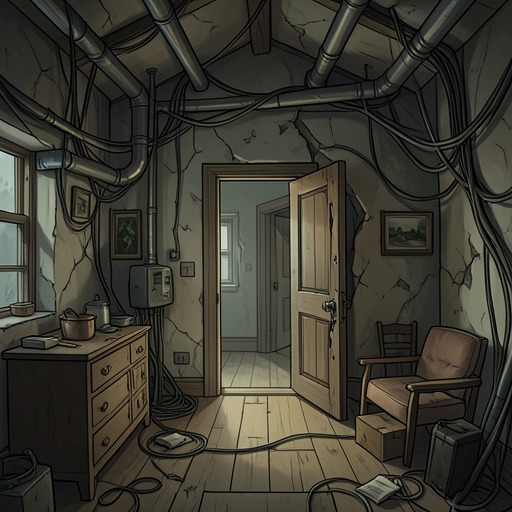
His later preparations extend beyond the staircase. After finding a broken Staffordshire figurine and reading Barbara Rose’s warning on his door, Oliver Rose removes bolts from the hinges of doors throughout the house, leaving them poised to fall at the slightest movement. He loosens supports and bolts in furniture, weakens kitchen fixtures and overhead pots, and places heavy cast-iron pots on the landing and stair risers. He loosens the brass banister and partially removes the carpet tacks so that contact with the rail could send the runner flipping toward the chandelier well. He also alters the clock’s pendulum and chimes and loosens picture fasteners in the library and parlor. His imagined chain reaction turns the whole house into a mechanism whose pieces might fall or shift together at a touch.
A house navigated as a trap
Barbara Rose does not meet these preparations with a simple attempt to reverse them. She hides in the attic, moving from place to place and learning the changed house by touch. During one excursion, she takes Staffordshire figurines from the library and parlor, crushes the Garibaldi figure, and scatters its contents outside Oliver Rose’s locked door. She writes a warning there in lipstick. The broken figure is both a material loss and a message: the collection, once a domestic possession, has become part of their language of threat.
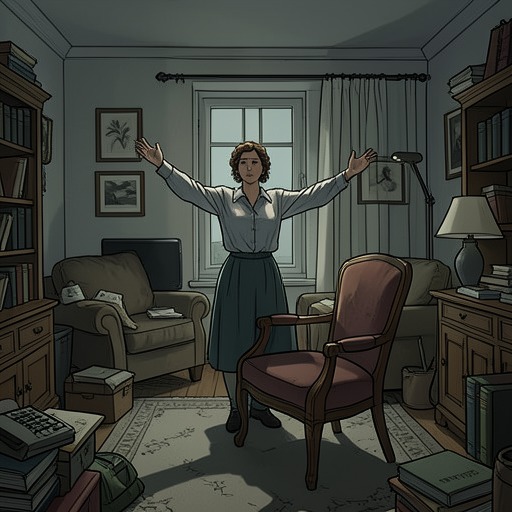
When she later moves downstairs, Barbara Rose detects the loosened carpet and banister and recognizes the altered shapes on the stairs. She slides down on her back, avoids obstacles on the flat surfaces, and uses a cleaver to climb the back stairs by digging it into the wall and pulling herself upward. Her knowledge of the house becomes a practical countermeasure to Oliver Rose’s attempts to make it hostile. The couple’s contest is no longer simply over who owns the rooms; it is over who can read and cross them without triggering what the other has changed.
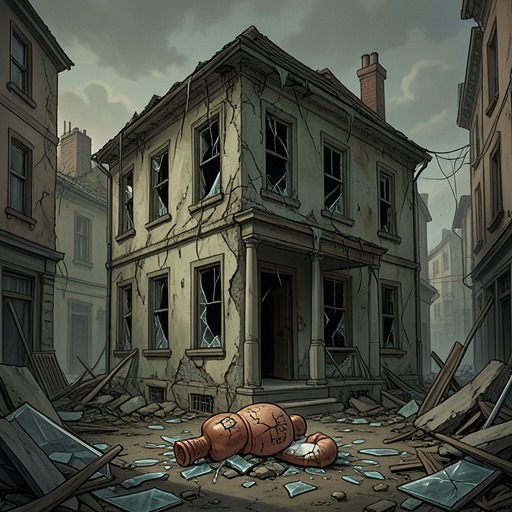
Oliver Rose’s traps and Barbara Rose’s evasions form an escalating cycle rather than a stable advantage for either side. His devices exploit doors, furniture, stairs, and fixtures; her responses turn workshop debris, broken glass, tools, and the figurines into weapons or signals. The domestic setting lends the conflict its particular force: familiar objects do not disappear but acquire threatening new uses. As the spouses alter the house to drive one another out, the shared home becomes less a refuge than a hazardous terrain that both must continually study, evade, and remake.